
GPS with CAN bus reading: why FMC150 tells you more about your fleet than any plain GPS
A plain GPS knows two things about a vehicle: where it is and how fast it is going. Everything else – consumption, mileage, fuel – it estimates. A GPS that reads the CAN bus doesn't estimate. It asks the vehicle. The Teltonika FMC150 has a CAN processor built in and reads fuel level, total fuel used, the odometer and RPM from the control units. Here is what that means in practice for a company with vehicles.
GPS estimates, CAN knows
When GPS counts kilometres, it adds up the distances between position points. Every tunnel, underground car park, signal dropout or bend between two points adds a small error. Over a year that adds up to hundreds of kilometres of difference against the odometer – and a trip log that doesn't match the odometer is the first thing that raises questions in an audit.
Consumption is even worse. Without vehicle data the system only calculates it from a model – from speed, time and the average consumption you entered. If the driver sits for an hour with the engine running, the model knows nothing about it.
The CAN bus is the vehicle's internal network where control units constantly exchange data. When the GPS connects to it, it gets exactly what the on-board computer sees. No model, no estimate.
What FMC150 reads from the CAN bus
Fuel level. The same value as on the dashboard. You see when the vehicle was refuelled, how much was added and how much disappeared.
Total fuel used. How many litres the engine really burned – including idling with the engine running.
Distance driven. The real odometer reading from the vehicle. Trip log mileage matches the dial.
Wheel-based speed, engine RPM and accelerator pedal position. The basis for driving style scoring that a driver can't fool by "driving slowly" at high revs.
The data available varies by make and model. Teltonika keeps a supported vehicle list – we check it for your vehicles before fitting. More about the bus itself in CAN bus and reading vehicle data.
Two devices in one body
Until now a separate CAN adapter was fitted next to the GPS unit. Two devices, double wiring, two places where a connector can come loose, and a higher fitting cost.
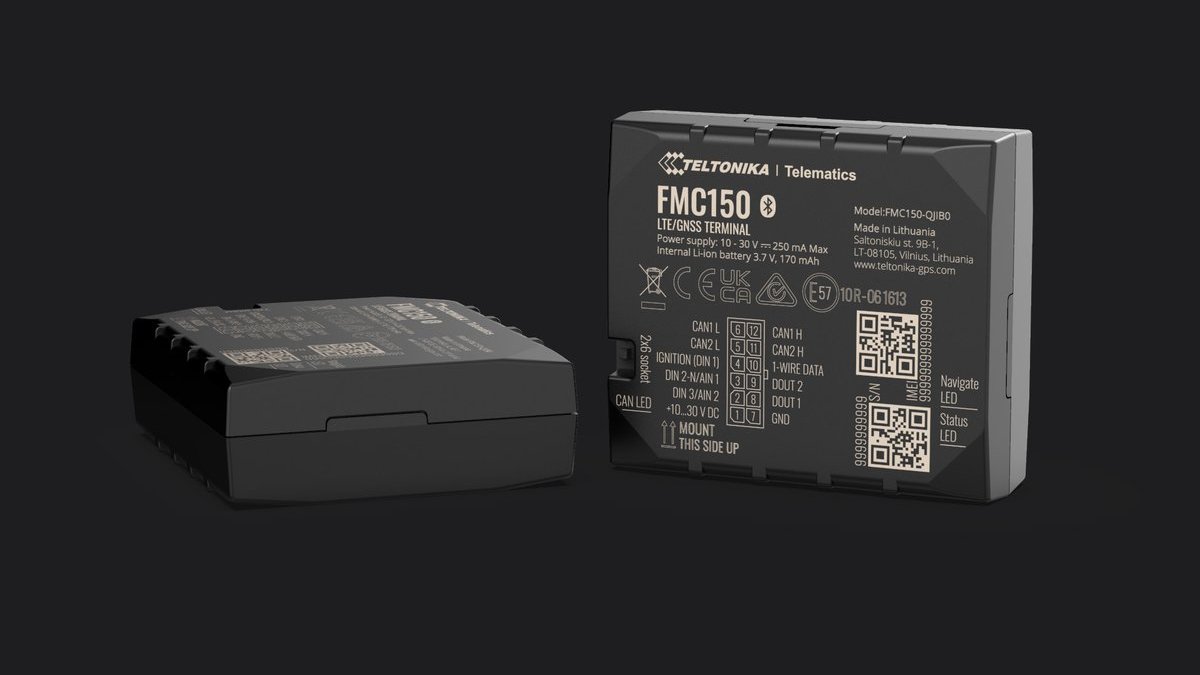
FMC150 has a CAN processor built in and two CAN interfaces. One unit measuring 65 × 56.6 × 20.6 mm and weighing 55 g that hides behind the dashboard. GNSS and LTE antennas are inside, no external antenna to route.
On the bus the unit is only a listener. It sends nothing to the control units and changes nothing – the vehicle drives exactly as before.
Where CAN data saves you money
1. Consumption that doesn't add up. Two identical vans, the same routes, one burns 2 litres per 100 km more. CAN data shows it per vehicle and per driver – and you know whether it's the vehicle or the right foot. More in our article on real vs. official consumption.
2. Idling. Engine on, vehicle standing. In winter outside the office, in summer for the air conditioning. RPM at zero speed shows it to the minute.
3. Fuel that disappeared. The tank level is what tells the truth about fuel theft. How receipts are compared with the tank is covered in how to detect fuel theft.
4. Servicing by real kilometres. Oil changes, timing belts, tyres – service planning by the odometer instead of an estimate.
5. A trip log with no guesswork. Odometer readings at the start and end of each trip, straight from the vehicle.
Cars, EVs, trucks, buses
FMC150 supports passenger cars and light commercial vehicles, electric vehicles, trucks and buses. It handles 10–30 V, so the same unit goes into a 12 V van and a 24 V tractor unit. With a mixed fleet you don't need three kinds of hardware.
On electric vehicles the CAN module reads data that a standard OBD unit often can't get. On trucks CAN is the only reliable route to fuel consumption – trucks don't have the passenger-car OBD socket.
FMC150, FMC003 or FMC130?
FMC003 plugs into the OBD socket under the steering wheel in seconds. Ideal for passenger cars where you want quick fitting without a technician. But it is visible and the driver can pull it out.
FMC130 is a concealed unit without CAN reading. Location, trip log, power disconnection alerts – at the lowest price.
FMC150 combines both: permanent concealed fitting and data straight from the vehicle, for vans, trucks and buses too. The choice for companies that want to manage fuel costs, not just track location.
Fitting: what to expect
A technician fits the unit. They connect power from the vehicle and two CAN wires behind the dashboard, without cutting the original wiring. It usually takes under an hour and the unit can later be removed without a trace.
The unit has a 170 mAh backup battery. If someone cuts the power, it reports it and keeps sending the position for a while. The accelerometer detects crashes, towing of a parked vehicle and GSM jamming. Via Bluetooth you add driver ID with a beacon, via 1-Wire an iButton reader and via an output an immobiliser.
Technical specifications at a glance
Connectivity: 4G LTE Cat 1 with 2G fallback, micro-SIM and eSIM. Positioning: GPS, GLONASS, Galileo, BeiDou, QZSS, accuracy under 2.5 m. CAN: 2 interfaces, fuel, consumption, distance, speed, RPM, accelerator pedal. Inputs and outputs: 3 digital inputs, 2 analogue, 2 outputs, 1-Wire, Bluetooth 4.0 LE. Power: 10–30 V, 170 mAh backup battery. Body: 65 × 56.6 × 20.6 mm, 55 g, IP41, −40 °C to +85 °C, 128 MB memory.
How much it costs
With monthly payment FMC150 costs a one-off 95 € excl. VAT and the service 3.80 €/month with no commitment. With annual payment a device worth 60 € is included in the package and for FMC150 you only pay the difference. The data SIM and coverage across Europe are included in the service.
Not sure which unit suits your vehicles? Send us the makes, models and years. We'll tell you which CAN data you'll get before you pay anything.
FAQ
What is a CAN bus GPS?
A GPS unit that, besides determining location, also connects to the vehicle's internal network (the CAN bus) and reads control unit data from it – fuel level, consumption, odometer, RPM and speed.
What data does FMC150 read from the vehicle?
Dashboard fuel level, total fuel used, distance driven, wheel-based speed, engine RPM and accelerator pedal position. The exact range depends on the vehicle model.
Is CAN more accurate than GPS?
For mileage and consumption, yes. GPS adds up kilometres from position points and estimates consumption from a model; CAN takes values straight from the vehicle's control units – the same ones the driver sees on the dashboard.
Can connecting to CAN damage the vehicle?
No. FMC150 is only a listener on the bus and sends nothing to the control units. A technician fits it without cutting the original wiring.
Does FMC150 work in a truck or an electric vehicle?
Yes. It supports cars and vans, electric vehicles, trucks and buses, and runs on 10–30 V, so it fits both 12 V and 24 V systems.
How much does the FMC150 CAN bus GPS cost?
With monthly payment 95 € excl. VAT one-off for the unit and the service from 3.80 €/month with no commitment. With annual payment you only pay the difference against the device included in the package.
How SaveTrack handles it: Encrypted GPS monitoring
Want to see fuel and mileage straight from the vehicle? Send your vehicle models to info@savetrack.sk and we'll check what FMC150 can read from them.
GPS tracking from 5.80 €/month, with the GPS device included on annual payment.
Order with no obligation