
Fuel theft: the tank does not lie. How SaveTrack catches siphoning and the jerrycan on the company card
Company fuel never disappears all at once. It goes litre by litre – overnight in a driveway, into a jerrycan on the company fuel card, on a receipt that has nothing to do with the vehicle. You will not see it on the invoice. You will see it in the tank. SaveTrack reads the fuel level straight from the car, matches it against receipts and trips, and tells you which vehicle, when and how many litres do not add up.
Five ways your fuel goes missing
1. Siphoning from the tank. A hose, a jerrycan, a night outside someone's house. In the morning the car starts as if nothing happened.
2. A jerrycan on the company card. The receipt says 55 litres, the company van took 35. The rest went into a can or a private car.
3. A receipt while the vehicle was elsewhere. The card was used on Saturday morning, while the van spent the whole weekend parked at the depot.
4. The wrong fuel. Petrol on the card of a diesel van. It certainly did not go into the van.
5. Slow skimming. Nothing dramatic – just a few dozen litres a month more than the mileage explains.
Each of these leaves a trace in the data. You just need to find it – and you do not have to do it yourself.
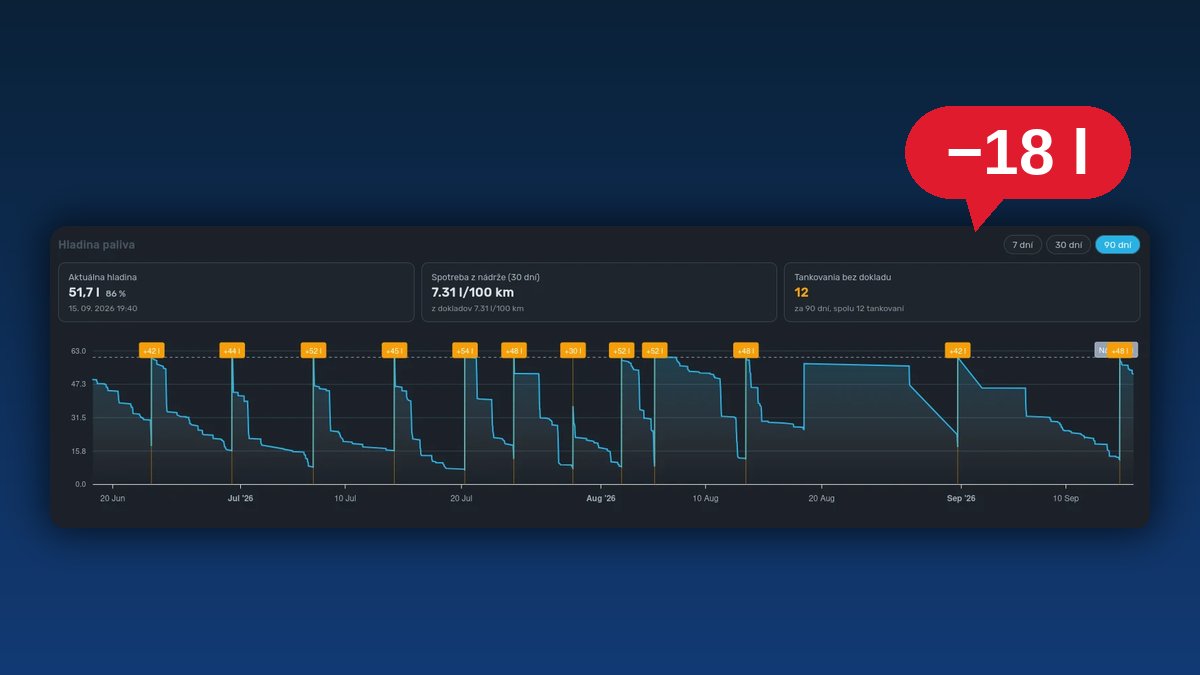
The tank graph gives siphoning away
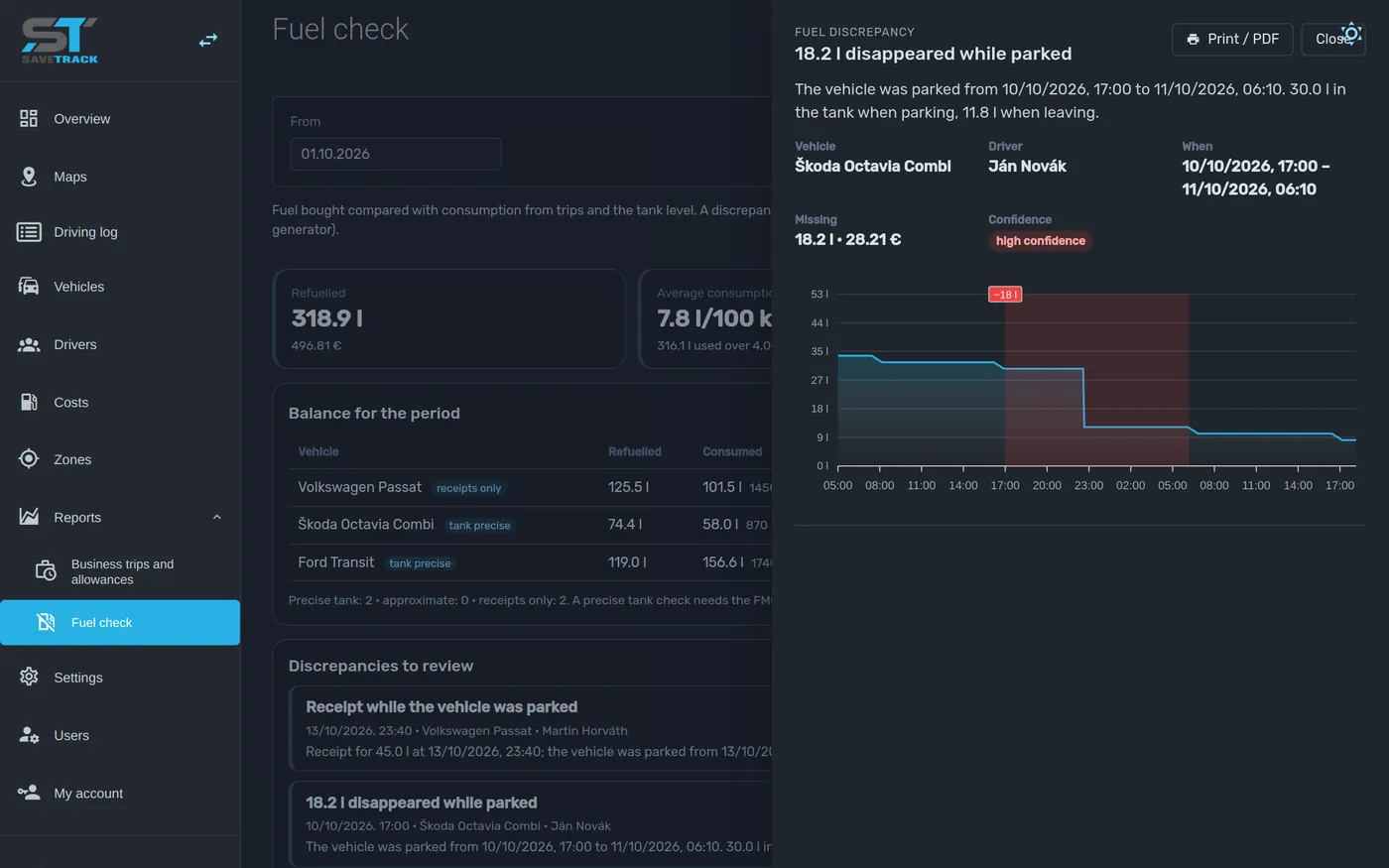
The FMC003 OBD unit reads the fuel level straight from the on-board computer – on supported cars to a tenth of a litre. When a parked car with the engine off keeps losing fuel, it shows as a step in the graph you cannot miss.
To avoid false alarms, SaveTrack accounts for how a fuel gauge really behaves: it keeps settling for a while after a trip, and parking on a slope tilts the reading until the car moves again. So it compares the level once settled with the level before departure and after pulling away. Only when litres are missing in all three readings is it flagged.
Every discrepancy also shows the driver who had the vehicle last before it was parked – taken from the trip log, not from guesswork.
Fuel card checks: receipt versus tank
SaveTrack detects every refuel in the tank on its own – it sees how many litres actually went in. Then it pairs the refuel with the fuel card receipt.
When the receipt shows more litres than reached the tank, when nothing reached the tank at all, or when the vehicle had been parked for hours at the time of the purchase (say a receipt at 23:40 while the vehicle stood still from 17:15 until morning), you see it right next to that receipt. The same goes for a receipt for a different fuel than the vehicle uses.
Why this is strong: it is not an estimate of consumption, it is two measurements of the same event. The pump says 55 litres, the tank says 35.
Monthly balance catches slow skimming
Small amounts get lost in a single refuel. Over a month they do not. For every vehicle and driver SaveTrack compares the litres purchased with what the vehicle should have used for the distance driven.
It does not take consumption from the brochure – that is usually well below real life. Where possible it measures it from the tank, otherwise from the vehicle's own refuelling history. This check works for every vehicle with receipts, even without an OBD unit.
How you find out
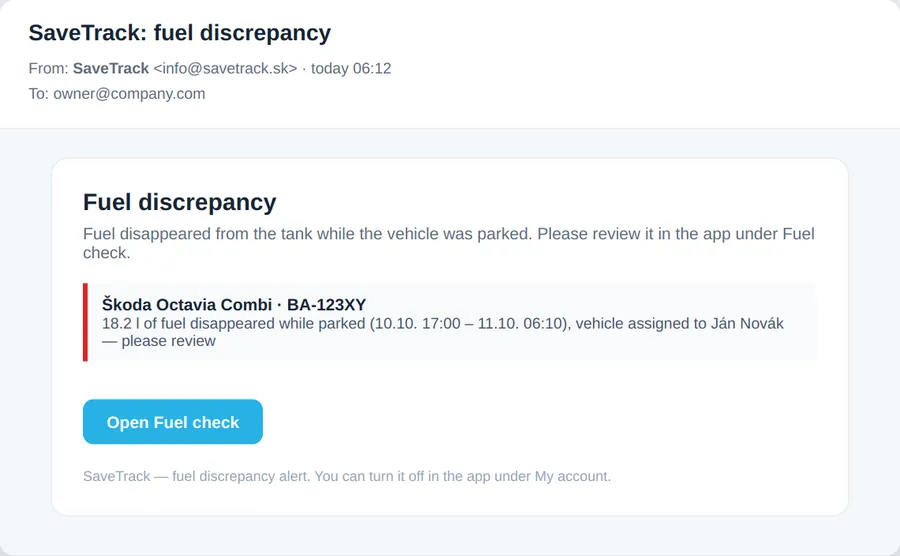
You do not have to check anything by hand. When fuel disappears from a tank overnight, you get an e-mail in the morning: which vehicle, how many litres, when it was parked and which driver had it. The instant e-mail is on by default; you can switch it off under My account.
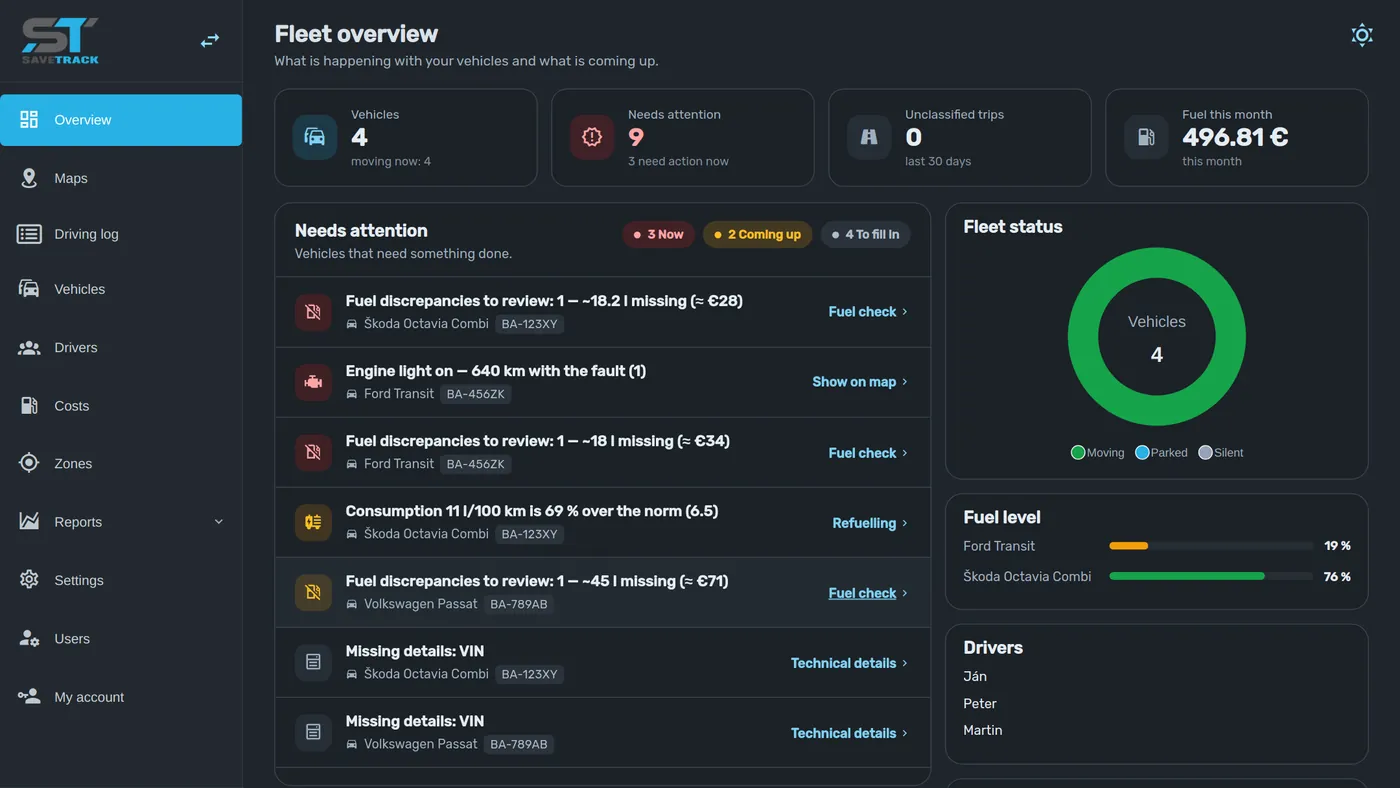
Other discrepancies – a receipt that does not match the tank, a purchase while the vehicle was parked, the wrong fuel – appear in the daily summary e-mail and on the dashboard right after you log in, under “Needs attention”. One click takes you to the Fuel check page.
What you see as the owner
On the dashboard, a line you cannot overlook: “2 fuel discrepancies – ~38 l missing (≈ €61)”.
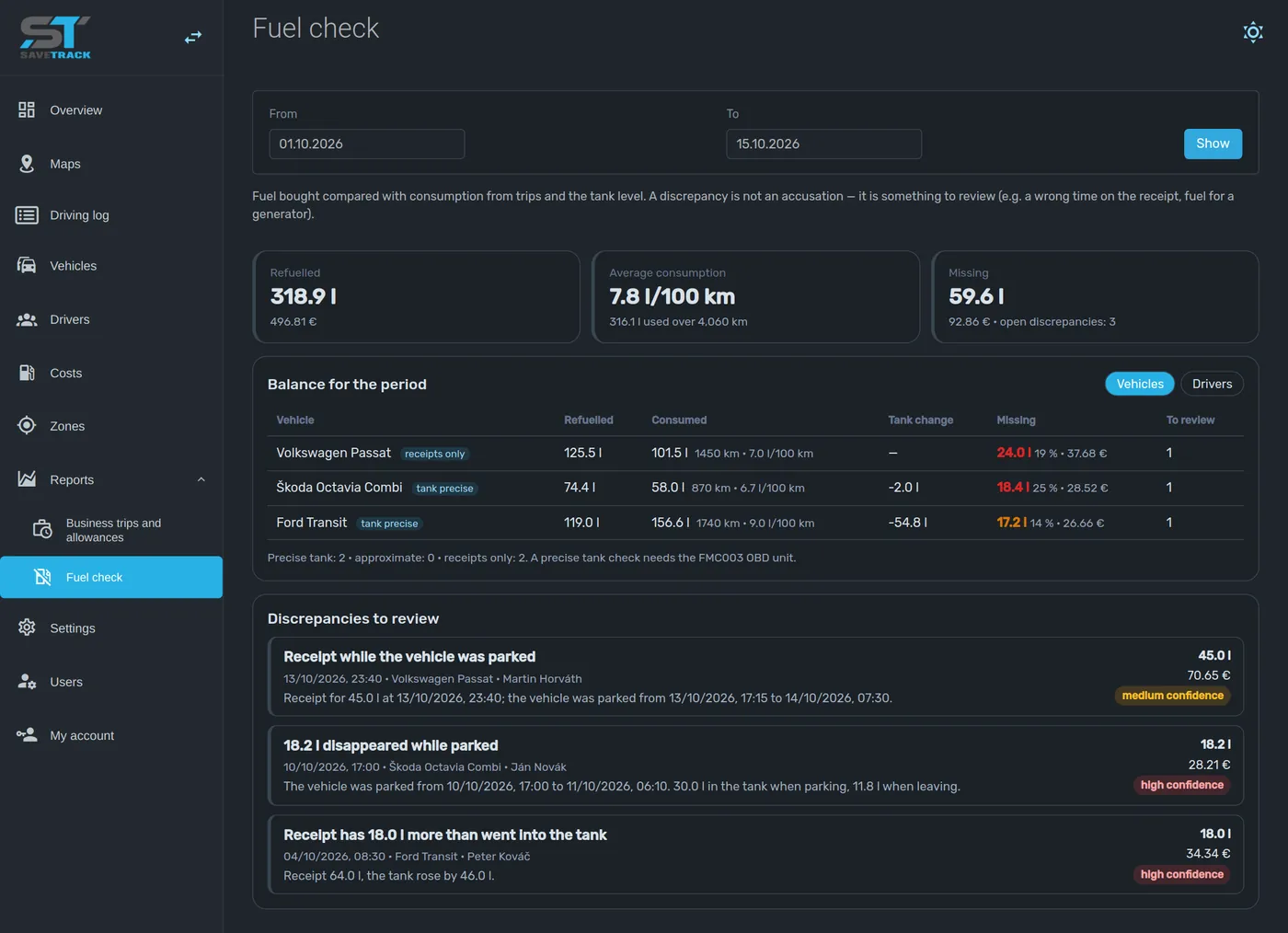
The Fuel check page (Reports → Fuel check in the menu) for the chosen period: how much you bought, the average consumption in l/100 km according to the trips, and how much is missing – in litres, percent and euros. Vehicles and drivers ranked by where the most is missing.
Every discrepancy in detail: the tank graph 12 hours before and after with the stop highlighted, the receipt next to the rise in the tank, the driver who had the vehicle, the time and how confident the finding is. One click marks it “OK” (say, “also filled the generator”) or confirms it – and every decision is logged.
When you need something to put on the table in a conversation with an employee, export it to PDF: graph, receipt, times.
What it can cost you – a worked example
An illustrative calculation, not customer data: say 20 litres a week go missing from one company vehicle. At around €1.50 per litre of diesel that is €30 a week, roughly €1,560 a year – from a single vehicle.
SaveTrack costs €6 a month per vehicle, and less every following year. You can do the maths.
A discrepancy is not an accusation
SaveTrack never says “theft”. It says “discrepancy to review” – on purpose. Missing litres may be a can for the lawnmower someone forgot to report, or a receipt assigned to the wrong vehicle. A person decides, not an algorithm.
Discrepancies are visible only to the account owner and whoever they allow. Drivers do not see them. And simply knowing that tank and receipts are compared is often the best prevention – while protecting honest drivers from needless suspicion. Remember that vehicle monitoring must be announced to employees in advance.
What you need
Precise tank measurement (siphoning, receipt versus tank) needs the FMC003 OBD unit and a car that reports its fuel level over OBD. Check yours in the list of supported vehicles. Some cars report the level only coarsely, in steps – then we catch only larger differences.
Without a tank reading we can still check receipts and the monthly balance – all it takes is fuel card or receipt data in the system.
For more on how companies lose fuel, read Fuel theft in a company and how to detect it. And you can try the app right now in the demo.
FAQ
How do I find out diesel is being siphoned from a company vehicle?
The FMC003 OBD unit sends the fuel level from the car. If more than about 5 litres disappear while the vehicle is parked with the engine off and do not come back after it pulls away, SaveTrack shows it as a discrepancy with the time of the stop and the driver who had the vehicle. With the instant e-mail switched on, you hear about it right away.
Will SaveTrack catch someone filling a jerrycan on the company card?
Yes, if the vehicle reports its fuel level and the card receipts are in the system. When a receipt shows significantly more litres than reached the tank, it is flagged on that refuel.
Does the fuel check work without an OBD unit?
Partly. Without a tank reading we compare receipts with trips and the monthly balance of fuel bought versus used. Siphoning from the tank cannot be detected without an OBD unit.
Will the driver see that they are under suspicion?
No. Discrepancies are visible only to the account owner and the users they allow. Driver access does not show them.
Can it be a false alarm?
It can, which is why SaveTrack never labels anything as theft. You review each discrepancy in the tank graph, against the receipt and the trips, and mark it as OK or confirmed.
Want to know whether your fuel is going missing? Try the demo at demo.savetrack.eu or write to info@savetrack.sk.
GPS tracking from €6/month, with the GPS device included on annual payment.
Order with no obligation